Decking Material NZ: Kwila, Vitex, Pine, Composite — Which Holds Up in Auckland

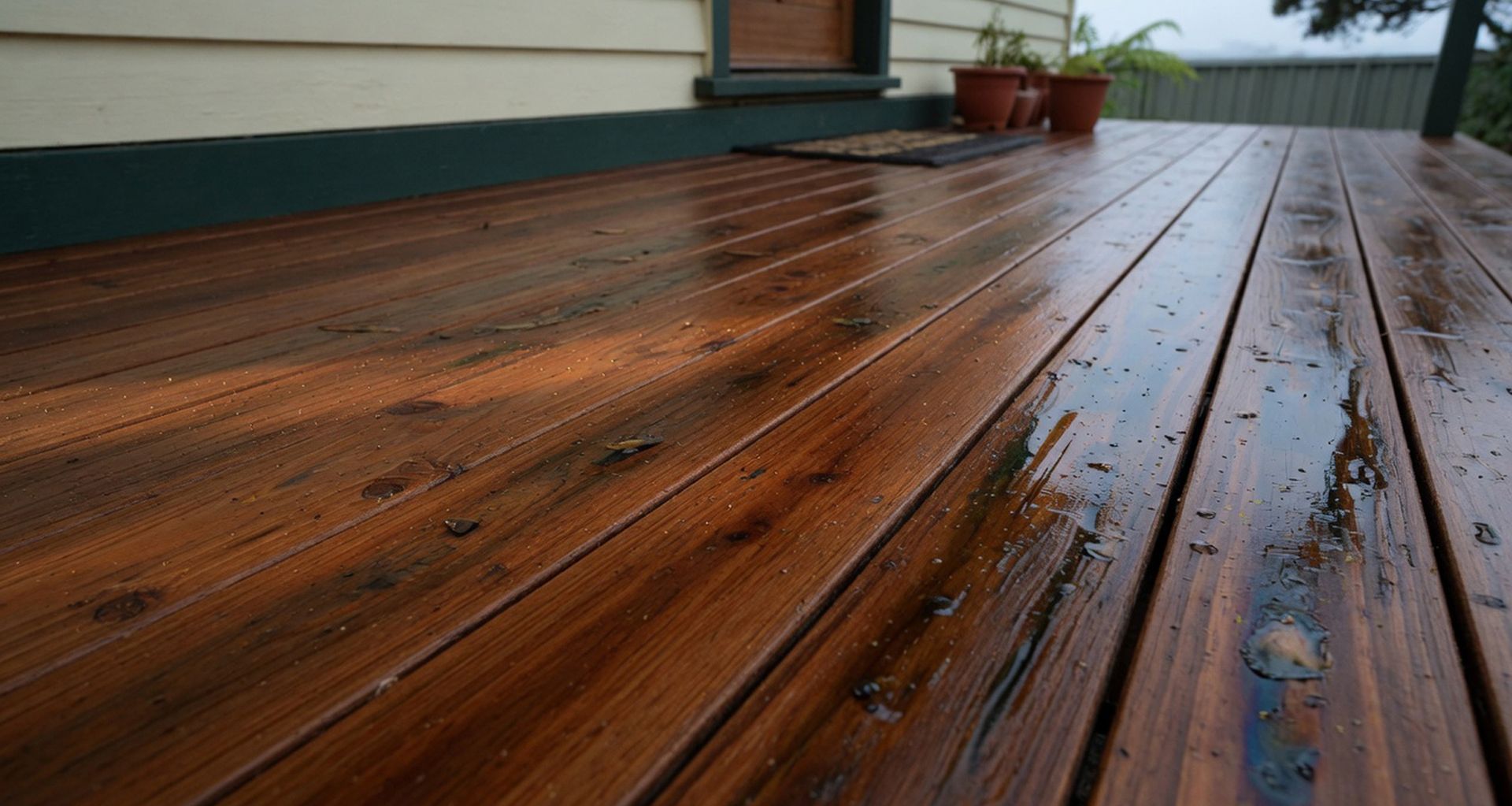
Decking Material NZ: Kwila, Vitex, Pine, Composite — Which Holds Up in Auckland's Climate
The decking material decision matters more in Auckland than it does in most parts of New Zealand. Sub-tropical humidity, salt air on the coast, intense summer UV, and long shaded periods under trees combine to age timber faster, swell composites, and expose every material's weakness within a few years. The deck that looks brilliant in the showroom photo may not be the right material for your particular section, climate exposure, or family use.
This is the honest comparison — kwila, vitex, treated pine, composite, and the secondary hardwoods (jarrah, blackbutt, garapa) — measured against how they actually perform across Auckland's conditions and what they cost to install and maintain. If you've already decided on kwila, our complete kwila decking guide covers the species-specific detail. This piece is for everyone still weighing the options.
Kwila — The Workhorse
Kwila (also called merbau outside NZ) is the most common premium decking timber sold in Auckland. The reasons it dominates the market: hard, dense, durable, naturally resistant to rot and insects, holds up well in coastal conditions, takes oil finishes deeply, and ages to a silver-grey if left untreated.
Performance in Auckland
Excellent. A properly-installed kwila deck lasts 25+ years in most Auckland conditions. Coastal exposure shortens that to 15–20 years if the deck is unprotected. Inland and shaded conditions extend it further. Kwila resists Auckland's humidity better than most hardwoods because of its natural oil content.
Maintenance
The trade-off. Kwila bleeds tannins for the first 12–24 months — meaning rusty-orange staining on concrete, paving, and pale paint surrounding the deck. Sealing with a quality decking oil twice in the first year mitigates but doesn't eliminate this. Beyond the initial bleed, kwila needs re-oiling every 12–18 months in coastal Auckland and every 18–24 months inland to preserve its colour. Left untreated, it greys out within 2–3 years.
The environmental honesty
Kwila is harvested primarily from old-growth tropical forests in Indonesia, Malaysia, Papua New Guinea, and parts of South-East Asia. Sustainability certification through FSC (Forest Stewardship Council) is available but not universal — much kwila sold in NZ doesn't carry FSC certification, and traceability claims should be checked rather than assumed. If environmental impact matters to your decision, ask your supplier for FSC-certified stock and the chain-of-custody documentation. Plenty of Auckland suppliers can provide it; not all do.
Cost
$110–$170 per square metre for the timber, $200–$280 per m² installed including substructure for a typical raised deck in Auckland.
Vitex — The Pacific Alternative
Vitex (sourced primarily from the Solomon Islands) has emerged in the last decade as an alternative to kwila with similar performance and a different sustainability profile. Some Auckland suppliers now stock vitex more heavily than kwila for exactly this reason.
Performance in Auckland
Comparable to kwila — naturally durable, holds up in coastal and inland conditions, ages to a similar silver-grey if untreated. Slightly softer than kwila, marginally more prone to surface marking from heavy furniture, but performs well overall.
Maintenance
Lower than kwila on the first-year tannin bleed front — vitex bleeds less and is more forgiving on adjacent surfaces. Same re-oiling schedule applies if you want to preserve colour.
The environmental position
Vitex from the Solomon Islands is more readily available with sustainability certification than kwila, and the supply chain is shorter geographically. Not perfect, but generally a more defensible choice if environmental due diligence matters.
Cost
$100–$160 per m² timber, $190–$270 per m² installed. Often a few dollars cheaper than equivalent kwila but variable based on supply.
Treated Pine — The Budget Option
H4-treated pine is the entry-level decking material. Roughly half the cost of kwila or vitex, structurally rated for ground contact, easily available from every timber supplier in Auckland.
Performance in Auckland
Adequate for budget projects but not premium. H4 treatment prevents rot and insect attack but doesn't prevent surface weathering, splitting, or the soft-and-spongy feel underfoot that develops over years. Lifespan with regular treatment is 15–25 years; without maintenance, 8–12.
Maintenance
Higher than the hardwoods. Pine needs annual cleaning and stain or oil application to look acceptable. Left untreated, it greys, splits, and looks worse than untreated kwila much faster.
When pine makes sense
Rental properties (low-cost replacement easier than premium-material maintenance), short-stay projects where the homeowner is renovating to sell, or specific design briefs where the deck is hidden under a permanent cover and visual quality doesn't matter.
When pine doesn't make sense
Anywhere the deck is the main outdoor living space of a home owner-occupied for 10+ years. The maintenance burden and aesthetic degradation usually frustrate within 5 years.
Cost
$45–$75 per m² timber, $130–$190 per m² installed. The big cost saving versus hardwoods is real but the lifecycle economics close the gap once maintenance is factored in.
Composite — The Maintenance-Free Promise
Composite decking (recycled wood fibre bonded in plastic resin) is marketed as the answer to timber's maintenance burden. Major brands available in Auckland include Trex, Outdure, Boardwalk, Modwood, and Newtechwood. The promise: no oiling, no staining, no splitting, no tannin bleed, 25-year warranty.
Performance in Auckland
Mixed. Modern capped composites perform far better than the first-generation products from the 2000s that warped, faded, and stained badly. Current premium composites genuinely deliver low-maintenance decking that looks consistent for 15+ years. But cheaper composite products still suffer from heat retention (composite gets significantly hotter than timber in direct summer sun — a real issue for bare feet on a north-facing Auckland deck), surface scratching from sand and grit underfoot, and colour variation between batches.
Maintenance
The lowest of any decking material when the product is good quality. Annual wash with mild detergent. No oiling, no staining, no resealing. The actual maintenance gap between composite and well-maintained timber is significant.
The honest trade-offs
Composite never looks like wood. It looks like very good composite, but the variation, grain depth, and patina that timber develops aren't replicated convincingly. The material costs more upfront than mid-grade timber. And the heat issue is real — composite in full sun in Auckland summer can be 15–20°C hotter than timber under the same conditions, which matters for bare-foot use.
Cost
$130–$220 per m² for material, $230–$340 per m² installed for premium composites. Cheaper composites are available but the lifecycle performance gap is meaningful — the long-term economics work better on the premium products.
"Composite makes sense on a coastal deck where the homeowner doesn't want to oil and stain every year and is willing to accept that composite doesn't look like timber. Composite doesn't make sense as a 'looks just like timber, no maintenance' product, because the first half of that claim isn't quite true. Once you accept it for what it is, it performs really well in the right setting."— Eunice Qin, Designer, Superior Renovations
Secondary Hardwoods — Jarrah, Blackbutt, Garapa
Less common in Auckland than kwila and vitex but worth knowing about for specific applications.
Jarrah
Australian hardwood, deep red-brown colour, extremely dense and durable. Excellent in coastal conditions. Cost $140–$200+ per m² timber. Lovely material but less commonly stocked locally — lead times can be an issue.
Blackbutt
Australian hardwood with paler tone — golden-honey colour. Holds finish well, durable, popular for contemporary designs where dark kwila isn't the aesthetic. Similar cost to jarrah. Supply has improved but still less consistent than kwila.
Garapa
South American hardwood, pale yellow-tan colour. Less common in NZ but available through some specialist suppliers. Performs well; the main appeal is the colour for designs wanting a lighter timber look.
Auckland Climate-Specific Recommendations
Coastal Auckland decks (Devonport, Mission Bay, St Heliers, Browns Bay, Takapuna)
Salt air ages all materials faster. Premium composite or naturally durable hardwood (kwila, vitex) outperforms treated pine substantially. Annual cleaning more important than inland. If using composite, choose capped products with UV stabilisation.
Wet / shaded Auckland decks (Titirangi, West Harbour, Glen Eden, bush-edge sections)
Algae and moss are the main issue. Composite handles this with annual cleaning. Timber needs more frequent treatment and can develop slipperiness from moss growth that doesn't appear on inland decks. Slip-rated timber profiles (grooved on one face) help.
Family decks with kids and pets
Composite reduces splinter risk but gets hot. Kwila and vitex develop a smooth surface over time that's fine for bare feet. Treated pine splinters more readily as it ages. The composite-vs-timber heat trade-off is most relevant here — test with bare feet at midday in summer before committing if this is your situation.
Entertainer decks with heavy furniture and BBQs
Composite scratches more readily than dense hardwoods. Kwila or vitex resists furniture marks better. BBQ fat spills clean off any surface but stain composite more visibly than timber in our experience.
The Cost Comparison Across 25 Years
Looking at lifecycle cost rather than just upfront cost changes the picture meaningfully. Indicative 25-year cost for a 30m² deck in Auckland:
Treated pine
Upfront: ~$5,400 installed. 25-year maintenance and replacement: ~$8,000–$11,000 in annual treatments and a likely full replacement around year 18–22. Total lifecycle: $13,000–$16,000.
Kwila
Upfront: ~$7,200 installed. 25-year maintenance: ~$4,500–$6,000 in re-oiling (every 12–18 months). No replacement needed if maintained. Total lifecycle: $11,700–$13,200.
Composite (premium)
Upfront: ~$9,000 installed. 25-year maintenance: ~$500–$1,000 in cleaning. No replacement. Total lifecycle: $9,500–$10,000.
Vitex
Similar to kwila — $7,000–$11,000 across 25 years depending on maintenance discipline.
The headline cheap option (treated pine) is often the most expensive across the life of the deck. Premium composite has the lowest 25-year cost despite the highest upfront. Hardwoods sit in between but deliver the aesthetic that composite can't.
The Decision in Practice
For most Auckland homes with a 10+ year horizon, the right answer falls into one of three lanes:
1. Kwila or vitex if you want the timber look, accept the maintenance, and want a deck that ages with character. This is the dominant choice for character home renovations and properties where the deck is a primary feature.
2. Premium capped composite if maintenance time is the constraint, you're willing to accept that composite doesn't look like wood, and the deck is a functional surface rather than an aesthetic feature.
3. H4-treated pine if the project is a rental, a sell-flip, or a budget-constrained primary residence where you'll accept the maintenance and replacement cost down the line.
The wrong answer for most Auckland family homes is the one chosen on upfront cost alone — pine that frustrates within five years, or cheap composite that warps and stains. The materials are good. The decision needs to match the way you'll use the deck.
FAQs
How much does a new deck cost in Auckland?
A standard raised hardwood deck of around 30m² costs $6,000–$10,500 installed depending on timber choice, substructure complexity, and access. Premium composite the same size runs $7,500–$11,500. Treated pine sits $4,500–$6,500. Multi-level decks, decks with seating built in, or decks requiring resource consent for height or boundary issues run higher.
Is kwila environmentally sustainable?
Kwila can be sustainably sourced with FSC certification, but a meaningful portion of kwila sold in NZ doesn't carry that certification. Ask your supplier for FSC documentation if sustainability matters to your decision. Vitex from the Solomon Islands tends to have better-documented supply chains.
How long does each decking material last in Auckland?
Treated pine: 15–25 years with maintenance, 8–12 without. Kwila and vitex: 25+ years with periodic re-oiling. Premium composite: 25+ years with minimal maintenance. Treated pine often gets replaced before that range due to aesthetic deterioration rather than structural failure.
Does composite decking really need no maintenance?
It needs much less maintenance than timber — annual cleaning rather than annual oiling — but it's not zero. Composite still benefits from periodic washing to remove pollen, salt, and surface debris. The marketing claim "maintenance-free" oversells the case slightly but the gap versus timber is genuine.
Do I need consent for a new deck in Auckland?
Decks under 1m above ground level often don't require building consent under Schedule 1 exemptions. Decks higher than 1m, decks attached to dwellings, decks within boundary setbacks, or decks with structural complexity (cantilevered, on slopes) typically do. Check before you build.
Where to From Here
Decking material is one of those decisions where the right answer depends entirely on what you value — aesthetic depth, low maintenance, low upfront cost, environmental footprint, longevity. There's no universal best. There's a best for your section, your usage pattern, and your tolerance for ongoing care.
We design and build decks as part of outdoor renovation projects across Auckland — Mt Eden, Ponsonby, Devonport, Henderson, Papakura, and everywhere in between. Book a free consultation and bring photos of your existing space. The material conversation gets clearer once we can see the site, the surrounding planting, the orientation, and how you actually plan to use the deck.