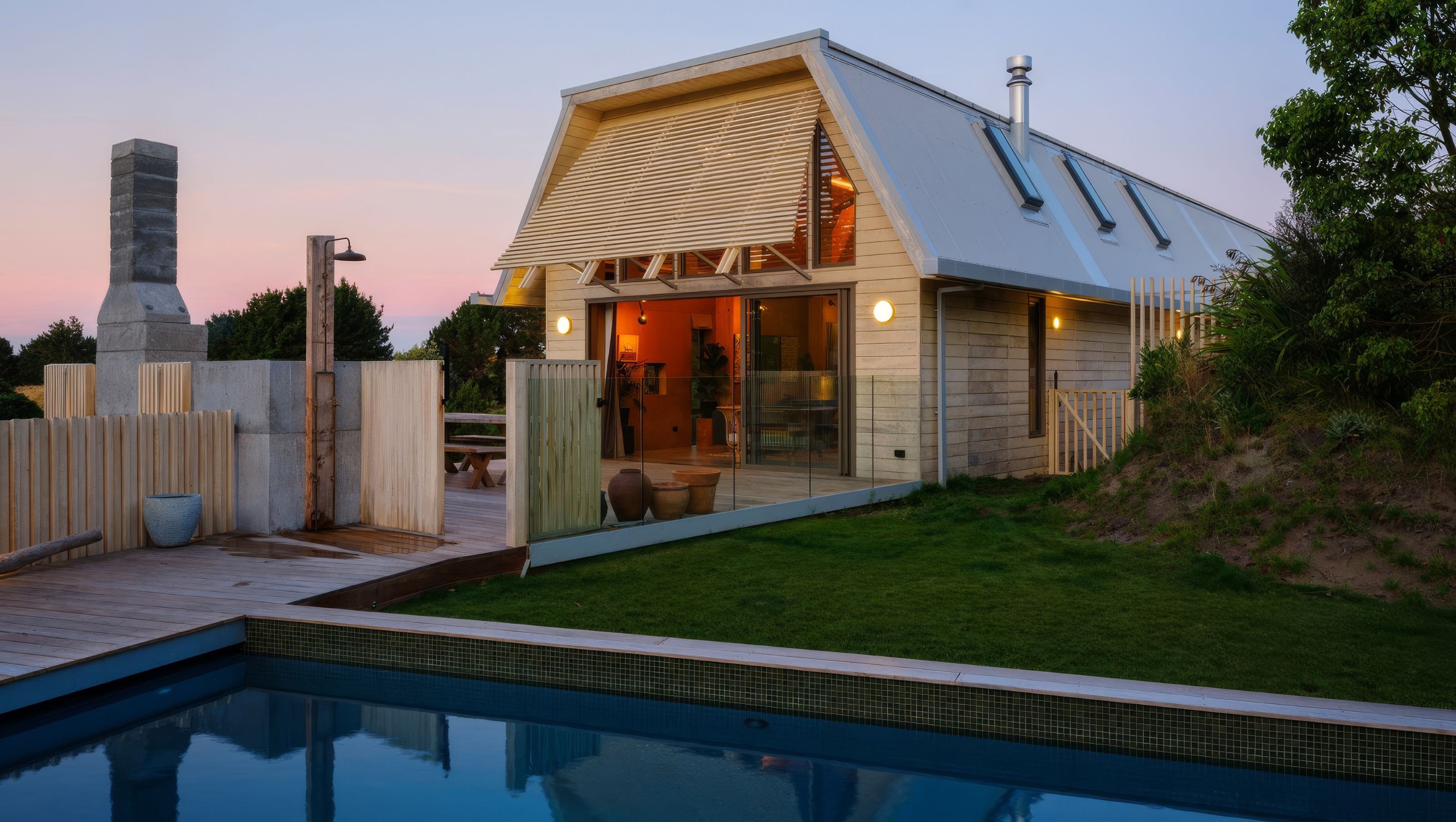

On a protected stretch of the Kāpiti Coast, this off-grid retreat pairs a radical form with the unmistakable magic of a restored wetland landscape.
A Japanese barn in the Kāpiti wetlands
On the Kāpiti Coast, between Waikanae and Te Horo, the land opens out into a restored wetland that feels almost magical in its presence. Dense with harakeke and native planting that has matured over decades, alive with birdsong and dappled light, it carries a depth that is hard to articulate but immediately felt. On one particular 16-acre stretch of this land, where Studio Pacific architect Stephen McDougall and his family have created their off-grid retreat, tradies arriving to fell a tree or fix a drain often find themselves lingering a little longer than expected.
As McDougall puts it, “People come here, and they’ll stop for a moment to take it in. They always say, ‘This is special.’”
It is this sense of recognition that defines the place. Long before McDougall and his partner Gretchen became its caretakers, the wetland had been painstakingly restored by a former owner, who replanted native species that now rise metres above the ground. Today, the land is protected under covenant, and with that comes a clear understanding of responsibility.
“As an owner, we are kaitiaki, guardians of the land—the guardians for now,” McDougall says.
Their role is not to dominate the landscape, but to live within it. And while the setting is extraordinary, the brief for what sits alongside it was grounded in something far more familiar: family. This is a holiday retreat designed to be shared widely, not just by McDougall and Gretchen, but by their three adult daughters, extended whānau, and a steady stream of friends.
“My partner Gretchen was always keen on it being a retreat in the wider sense of the word,” he explains. “We’ve got quite a big family, and we wanted a place that everyone feels comfortable in.”
That idea of comfort extends beyond physical design. It is about ease, about creating a place where people feel comfortable asking if they can stay.
The site itself evolved gradually. Early visits were spent in a caravan, set beside an existing constructed barn fitted with a simple, DOC-style kitchen and bathroom. It was a pragmatic beginning, one that allowed the couple to understand the rhythms of the land before committing to a permanent structure. The original cottage, which once occupied a prime position, was later moved down a steep bank, clearing the way for an orchard of fruit trees that now marks its former footprint.
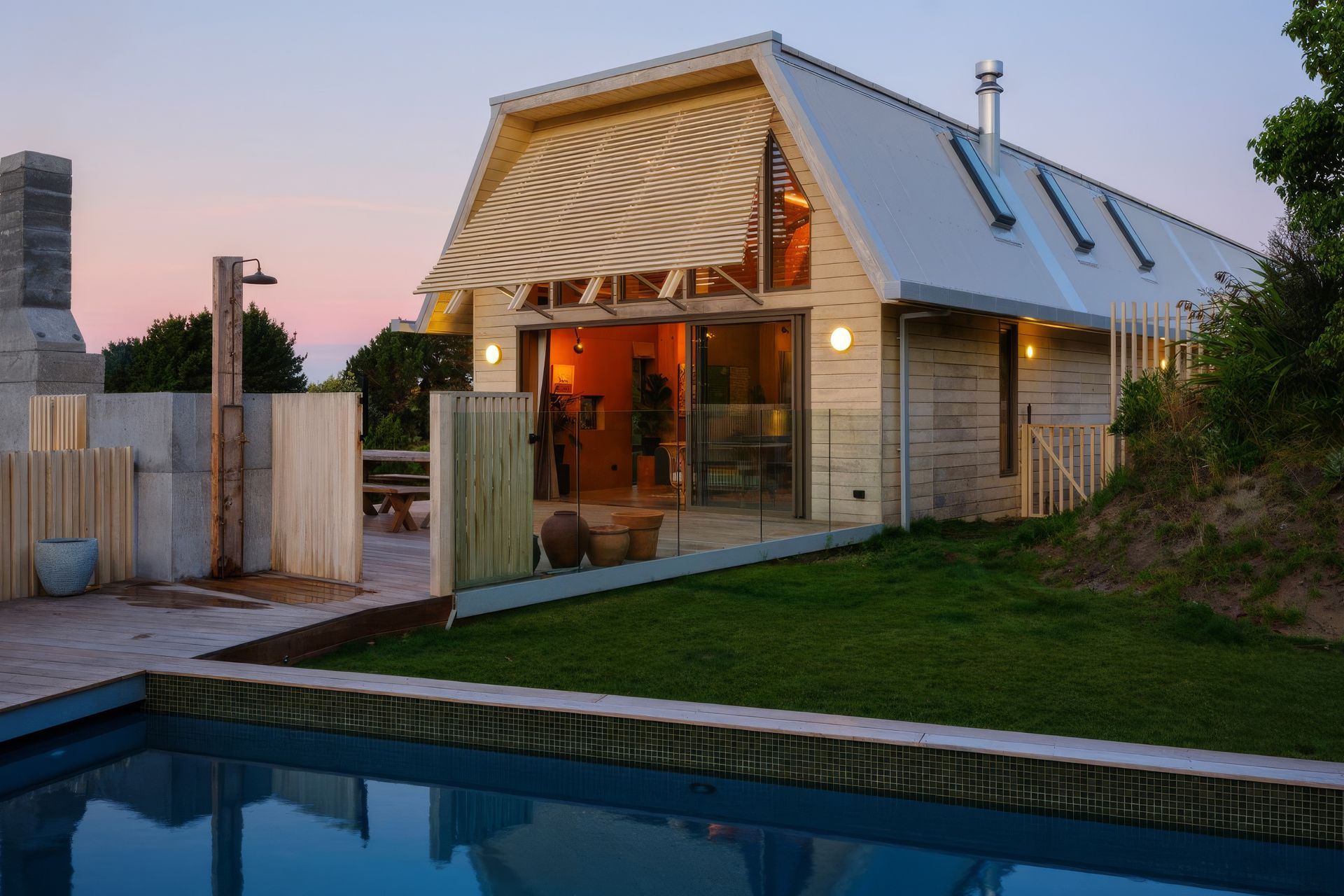
The house that followed was carefully positioned along a contour, balancing exposure and shelter. From here, the sea sits just a kilometre away, visible across paddocks and wetlands, yet the house remains protected from the harsh coastal winds. The challenge lay not in the wind, but in the sun. With little natural shading, the potential for excessive heat gain was significant.
The solution emerged during a trip to Tokyo, where McDougall encountered a building by Herzog and de Meuron that would shift his thinking entirely.
“It’s a building that doesn’t appear to have walls, at least not in a traditional sense,” says McDougall. “I’d been asking myself how we could be really conscious of our environmental footprint, still shade the house, while also capturing the views of the sea and wetlands.”
The penny dropped, and from that moment came a reworking of the house form. Rather than relying on conventional walls, the roof itself extends downward, becoming both enclosure and shelter. Deep eaves provide protection from the sun, while carefully placed openings maintain a strong visual connection to the landscape.
There was, inevitably, pressure in designing a home for oneself. Beyond the architectural ambition, the house needed to meet the practical demands of family life. It had to be cost-effective, energy-efficient, off-grid, and capable of hosting large groups, while still feeling intimate when occupied by just two.
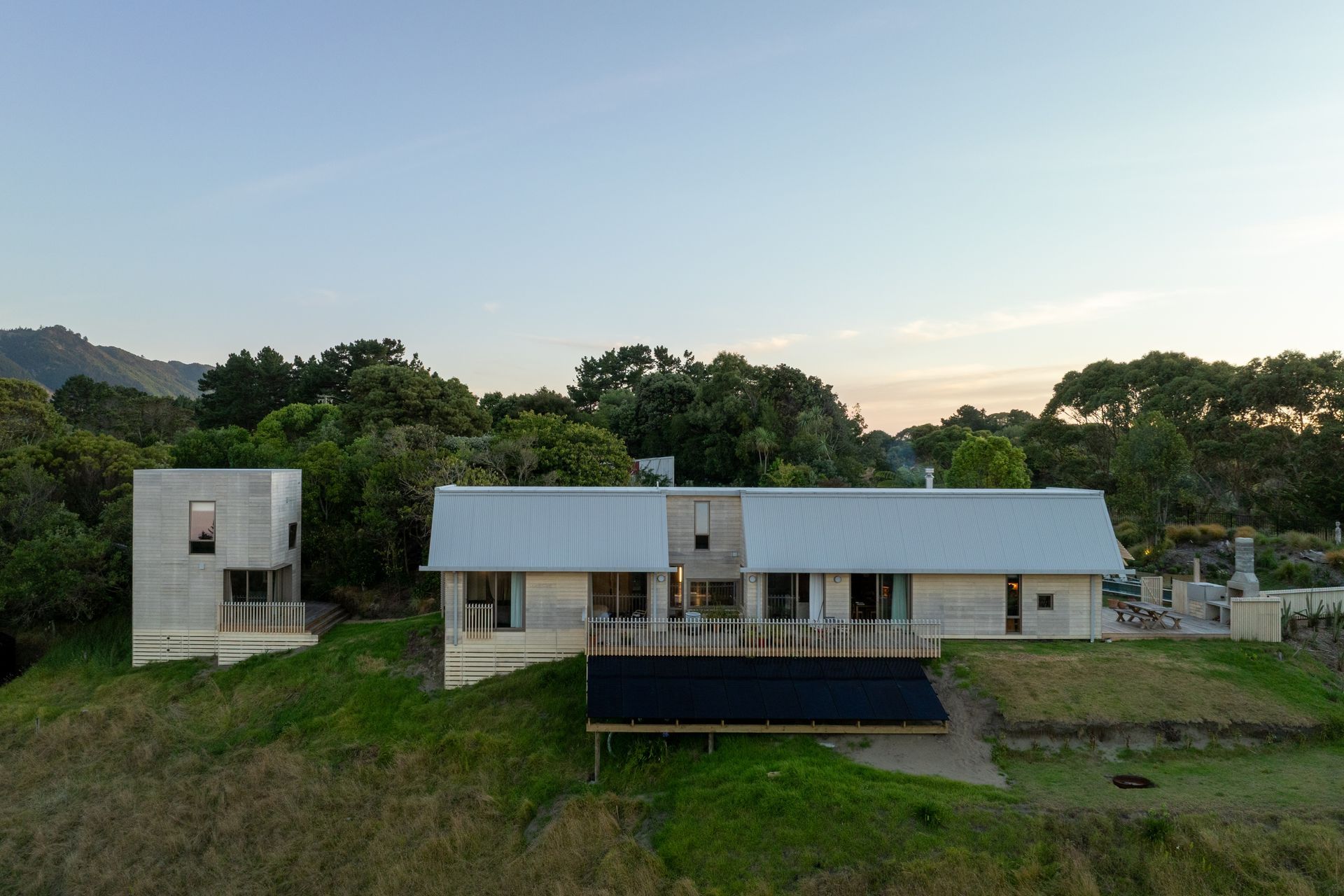
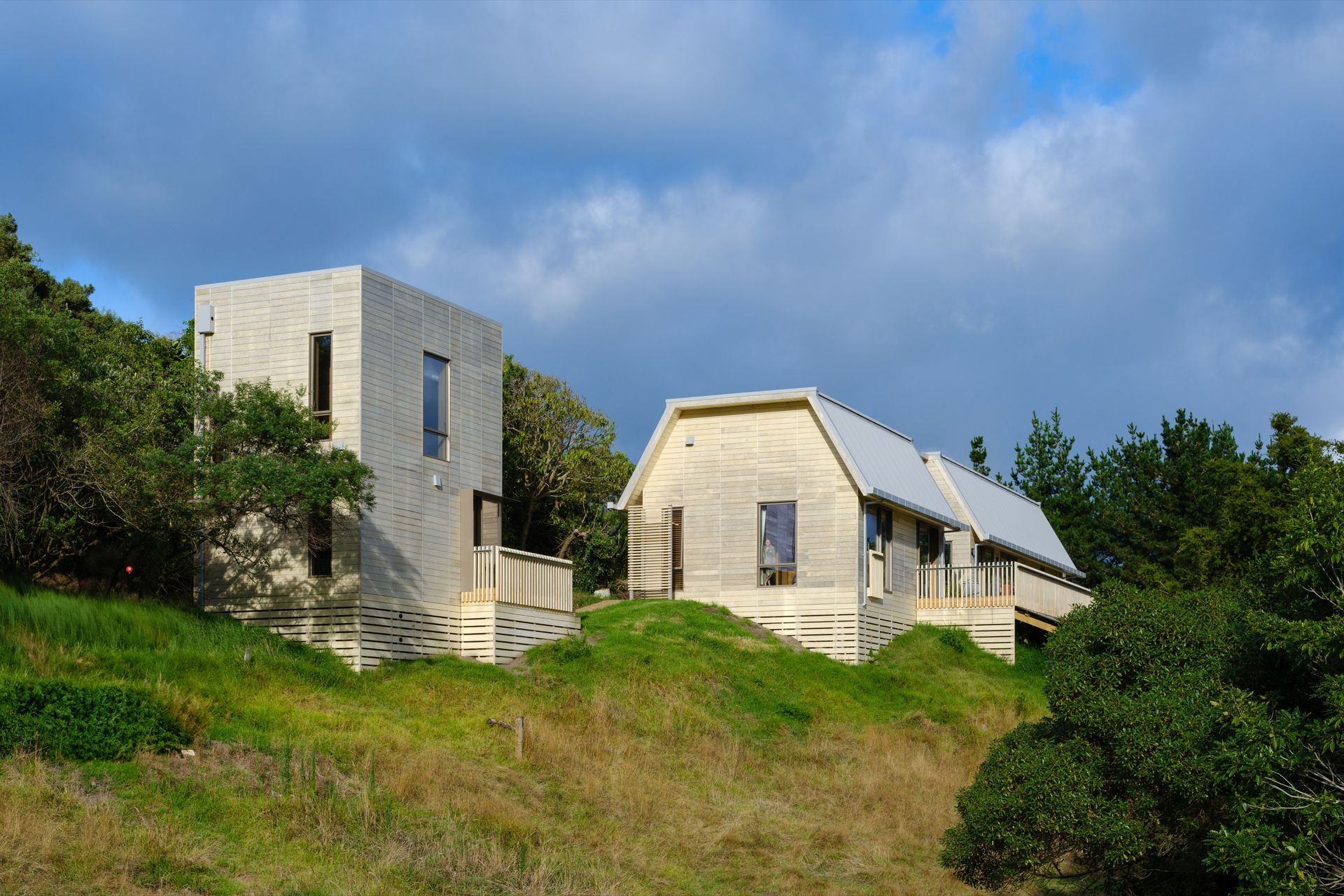
The result is a collection of spaces that work together rather than as a singular object. The main house is supported by a tower and additional sleeping areas, allowing people to spread out across the site. Tents are often pitched in the surrounding grounds, reinforcing the sense that this is less a house and more a gathering place.
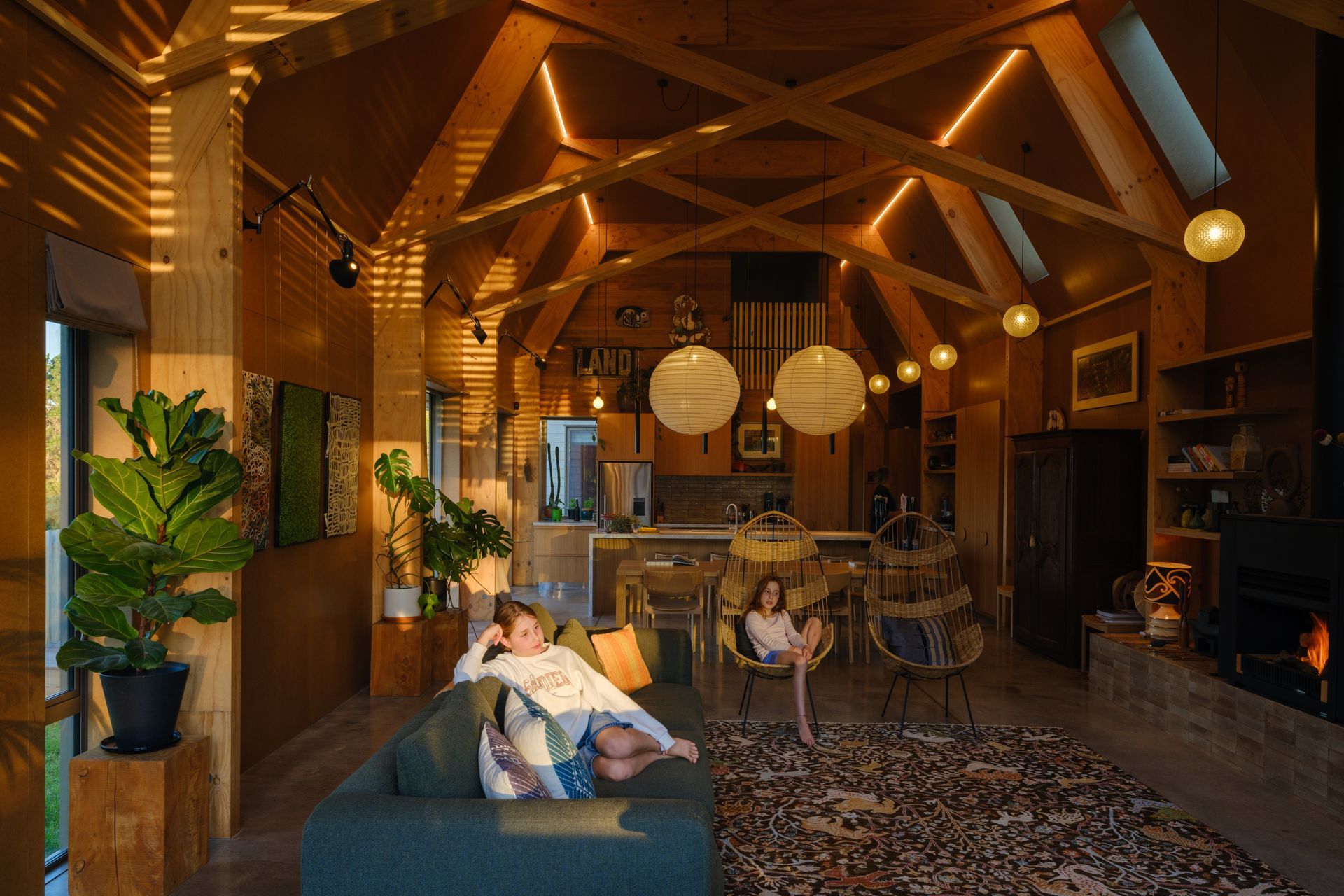
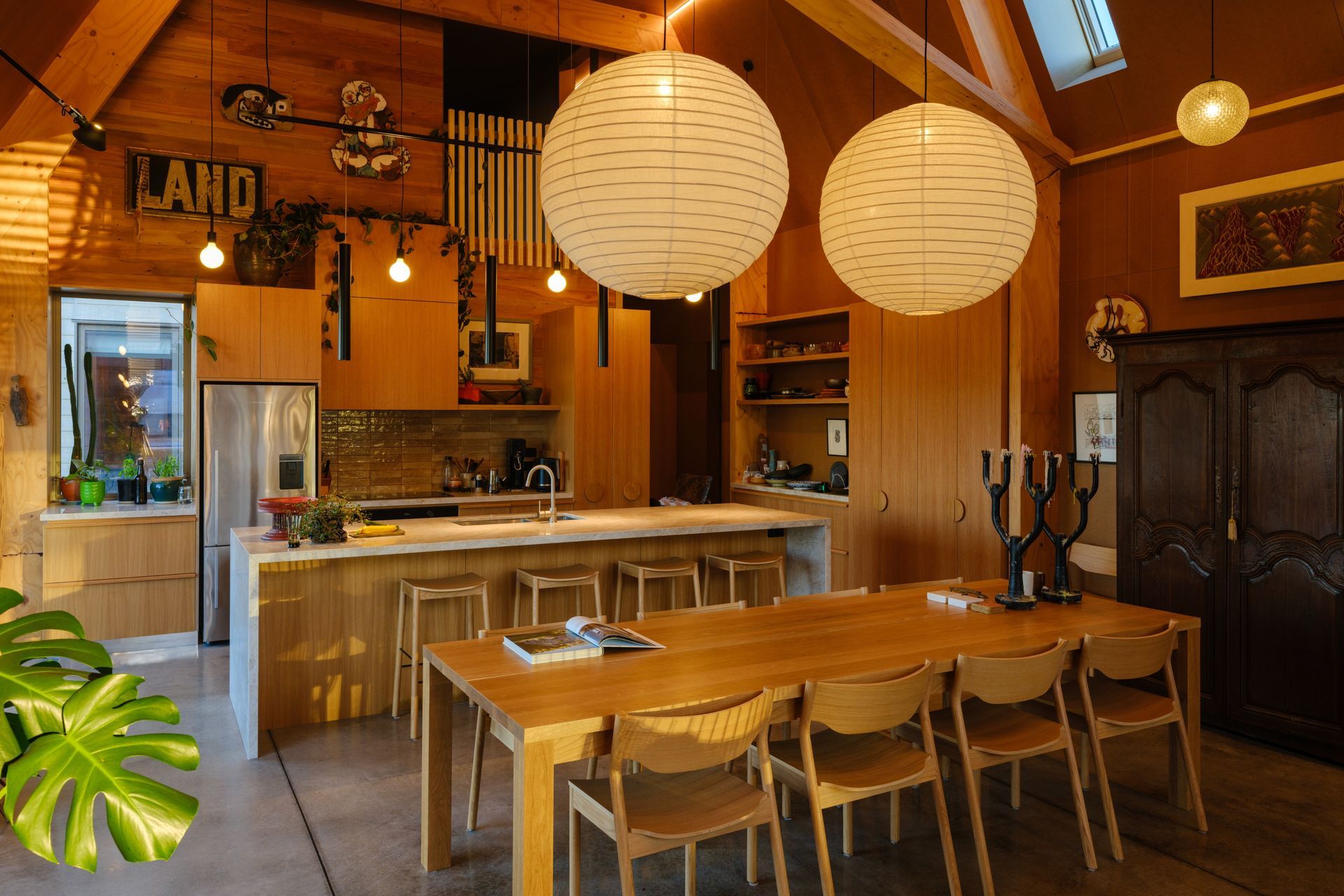
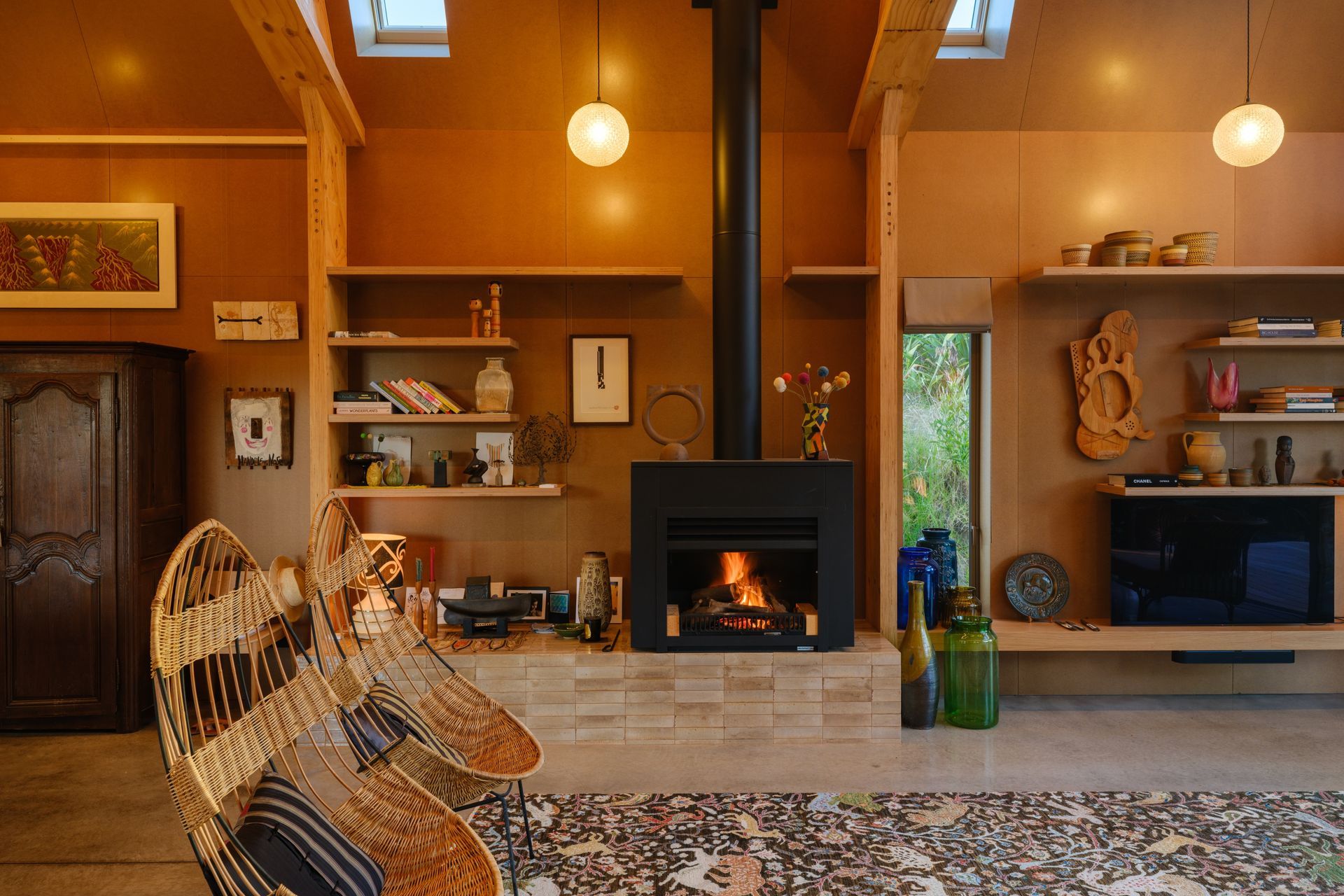
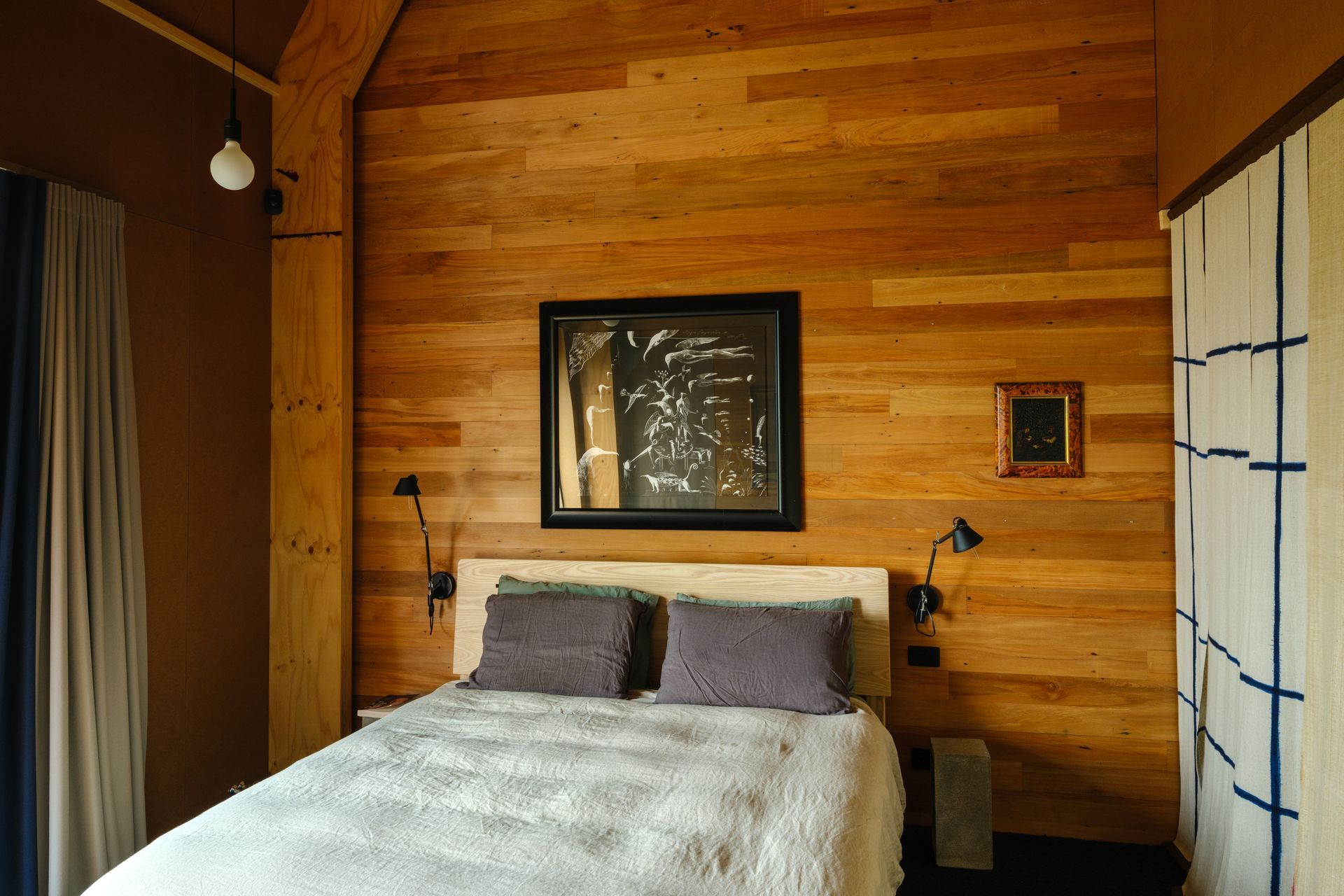
Inside, the material palette is deliberately honest. LVL trusses create the dramatic volumes, while all longitudinal walls and ceilings are clad in tempered hardboard, its subtle fleck giving it a warmth that belies its modest cost. Recycled rimu wraps the shorter cross walls. There is no plasterboard, and almost no paint. Instead, colour appears in small, deliberate gestures, a strip down the edge of the doors, a shift in carpet tone, and a drape stripe.
The interior feels personal and layered. Fabrics collected over years of travel have been repurposed throughout, used as curtains and wardrobe coverings.
“We have a lot of beautiful fabrics,” McDougall says. “We don’t have any wardrobe doors—we’ve used fabric instead, which provides another softness to the bedrooms.”
The effect is one of texture and warmth, a space that feels lived in rather than styled.
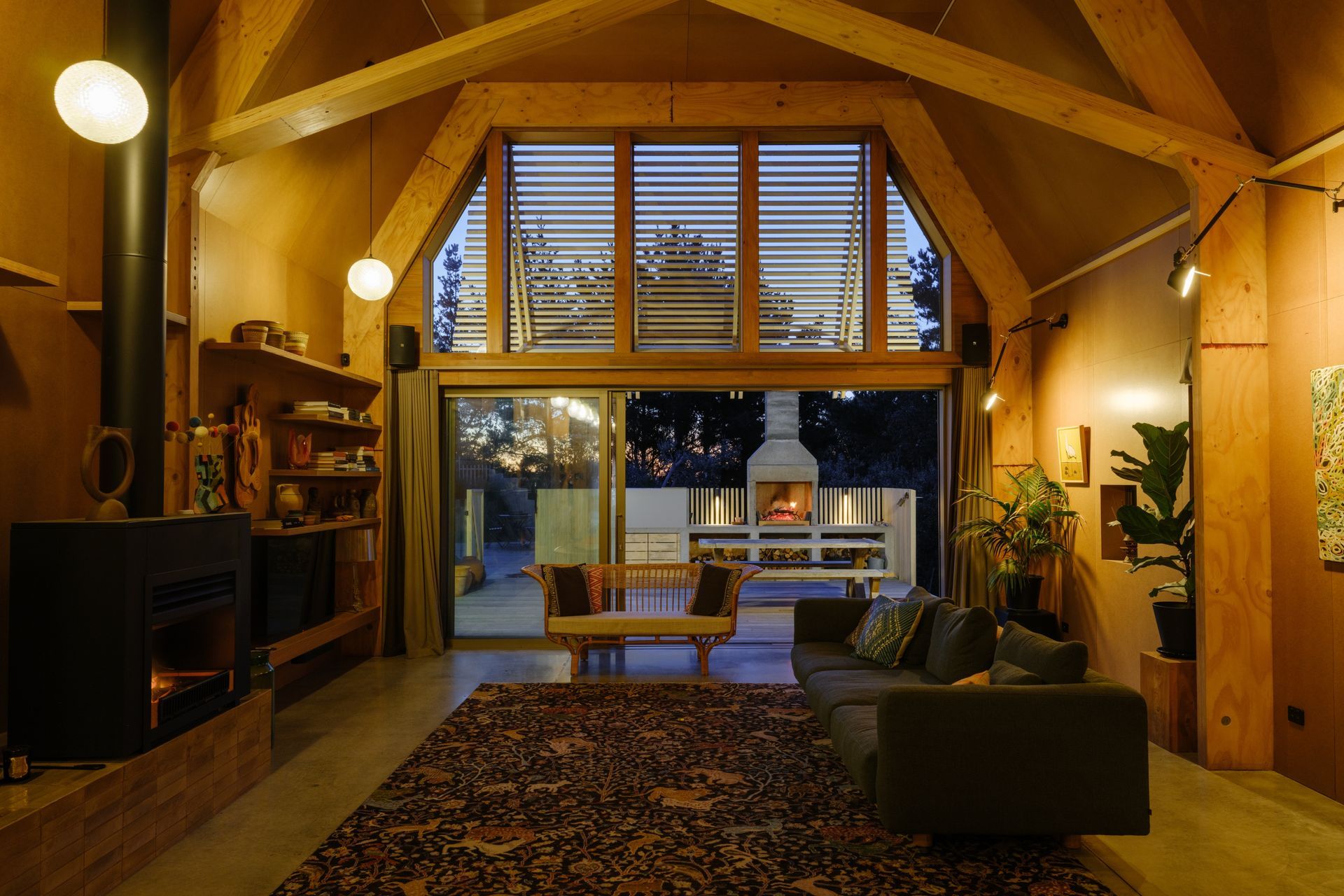
Despite the scale of the main living area, the house holds a surprising intimacy. Careful attention to thermal performance ensures it remains comfortable year-round, while lighting and materiality draw the volume inward, creating moments of closeness within the larger space. It is as suited to a quiet weekend as it is to a full house.
That flexibility has become one of its defining qualities. Since completion, the house has hosted everything from family gatherings to large events, absorbing each with ease.
“It does feel perfectly fine for one person in the room, or two people, or 25,” McDougall reflects.
For him, the most rewarding aspect is not the architecture itself, but the way it is used. The steady flow of visitors, the ease with which people arrive and settle in, speaks to something deeper than design.
“What I really like is that people are really comfortable there,” he says. “They feel comfortable when they’re there, but also just rocking up.”
In the end, this is a place that resists preciousness. It is robust, generous, and quietly joyful, a home that holds space for others while remaining grounded in its landscape. Much like the wetland it overlooks, it is the result of care over time, and a belief that the best places are those that are shared.
Words: Jo Seton
Additional info:
Located on a 16-acre site just inland from the Kāpiti Coast, the house is made up of two forms - a barn and a keep - that step across a natural rise in the land. The main house contains shared living and sleeping spaces, while the adjacent two-storey tower offers flexible guest accommodation. A series of exterior spaces sit into their specific contours and are configured to create exterior rooms with distinct character. The pool encloses that the orchard, the space between the two main built forms, and the regenerative permaculture garden all add to the richness of the home.
Inside, the architecture is calm and characterful. The main living space is defined by tall, dramatic volumes and exposed LVL trusses. All longitudinal walls and ceilings are clad in tempered hardboard, while cross walls are lined with recycled rimu. There is no plasterboard; surfaces are left largely untreated, with just a clear protective coat to preserve the tone and tactility of the materials. Simple detailing, restrained junctions, and honest finishes allow the structure to take the lead.
Colour is used sparingly but purposefully. The ends of interior doors are painted to match the colour of each room, while drapes feature subtle two-tone flashes. Instead of conventional wardrobe joinery, textured fabric panels from Laos and Indonesia hang in soft contrast to the timber linings. The result is a home that is informal and rich in personality – a quiet backdrop for daily life, art, and collected objects.
This is a house designed to hold whānau and visitors, daily life and quiet retreat. Its strength lies in its simplicity – technically rigorous, deeply personal, and built to last.
Designed for the Environment
- Carbon-positive and net-zero energy, with the potential to be off-grid
- Solar generation, rainwater collection and on-site treatment system
- Passive thermal design with no active heating or cooling required
- Externally insulated envelope and deep eaves for seasonal comfort
- No plasterboard – all finishes are natural
- Low-carbon concrete
- Wool insulation
- Wool carpets and drapes
- Exterior clad in 1200mm modules of Acoya.
- Completed
- 2025
- Building style
- Cabin




Awards
Living Space of the Year
HOME Interior of the Year Awards
Bronze Pin
Best Design Awards, (Spatial – Residential)
Like this Project?
Hire Studio Pacific Architecture
The products behind the project
Five products specified into this build from five suppliers, verified ArchiPro members. Tap through to specifications, suppliers and lead times.


Professionals used in
this project
The practices and trades credited on this project.







More projects from
Studio Pacific Architecture
Other work by Studio Pacific Architecture, across every category they build in.


More in
Outdoor Living
Everything else in Outdoor Living, from every practice on ArchiPro.


Next Project
Keep scrolling