

Sustainable off-grid cabin designed for a retiring farmer, featuring passive solar orientation, high-efficiency Structural Insulated Panels, and a comprehensive renewable energy system, all while preserving expansive views of a private lake.
Super sustainable off grid home on the edge of a lake
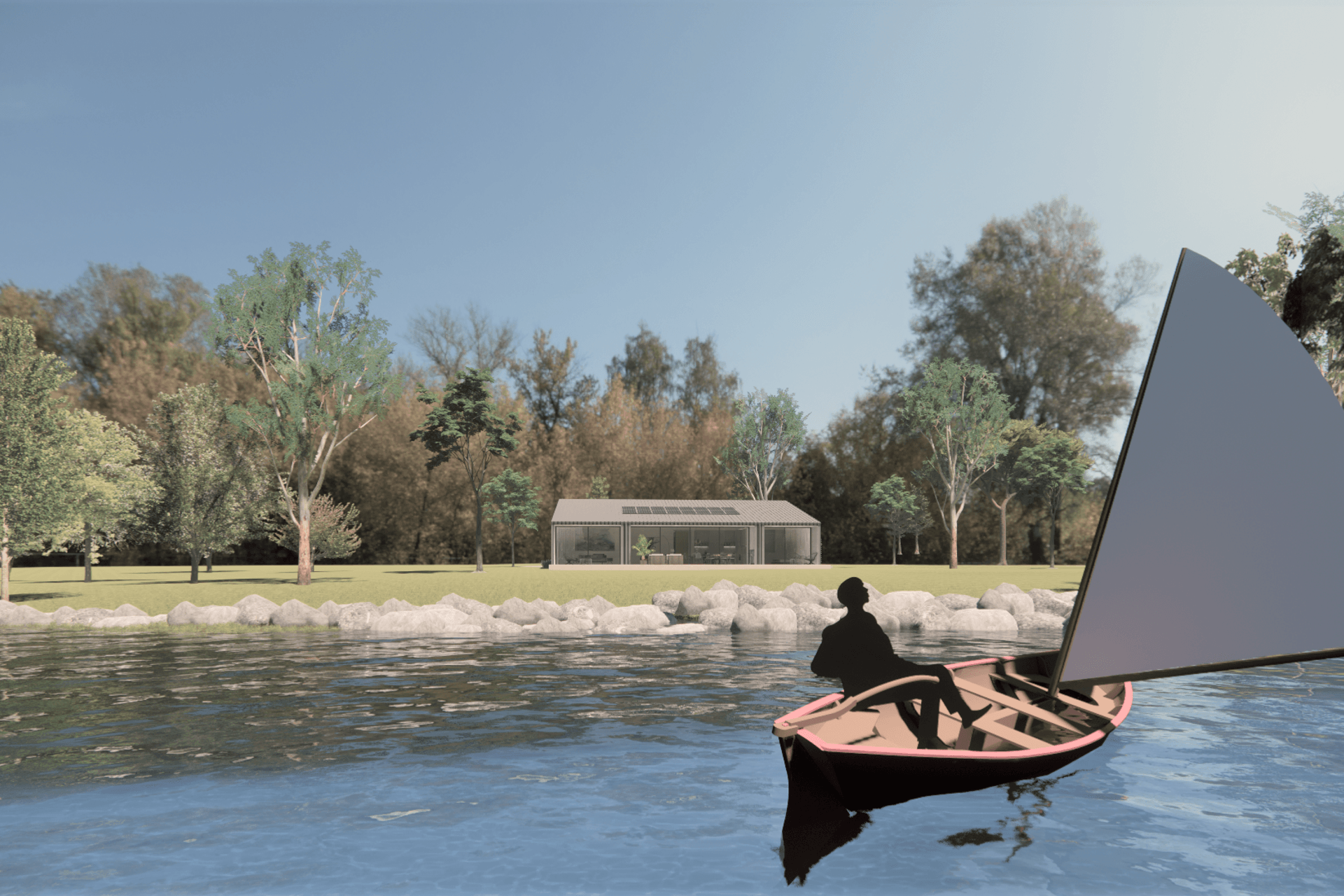
Our client, a retiring farmer and his wife approached us to design a low impact off grid building overlooking their private lake. They wanted to downsize into a home that would be as sustainable as possible but with expansive uninterrupted views of the lake to be maintained. Our approach firstly was to ensure the building was oriented ideally with overhanding eaves to control sun penetration. The passive solar approach is one of the most important avenues to creating a low energy building. We undertook a series of 3D massing studies to determine the best possible height and depth of the eave to allow us to have a fully glazed north façade. We had 75% of our overall glazing on this northern façade and limited windows elsewhere so that we could control heat gain from the east and west and heat loss through the southern façade.
The property has no mains connections so we proposed a worm farm septic system, all electric home with solar power and battery, large rainwater collection tanks and purification systems with electric heat pump hot water systems and maintaining the natural indigenous landscape in lieu of introducing manicured gardens to eliminate the need for irrigation.
The building structure is 100% Structural Insulated Panels (SIPs) which have an extremely high level of continuous insulation that wraps to different building elements without gaps. it is also thermal bridge free meaning there are no highly thermal conductive building elements that span from outside to inside which controls condensation risk and heat loss. We also proposed to tape the joins between the SIPs panels and around all window and door frames to achieve an extremely high level of airtightness. A blower door test will be undertaken to ensure the airtightness is below 0.6ACH@50 pascals which is the minimum standard required to achieve Passive House certification.
The windows and doors are extremely airtight and thermally efficient but can all be opened and closed as you would expect in a normal house. Finally, the home is fitted with a heat recovery ventilation system. This mechanical unit runs on very low power 100% of the time. It has been designed to remove the stale and wet air from kitchens, bathrooms and laundries, but before it is exhausted, the heat is captured so that energy loss is limited. It then takes in fresh outside air, filters it and mixes it with the captured heat before delivering it to all the living, bedroom and study spaces.
Status: Pre-construction stage



Like this Project?
Hire Borland Architecture
Professional Reviews
Professionals used in
this project
The practices and trades credited on this project.

More projects from
Borland Architecture
Other work by Borland Architecture, across every category they build in.


Next Project
Keep scrolling